
Jump to
Short answer
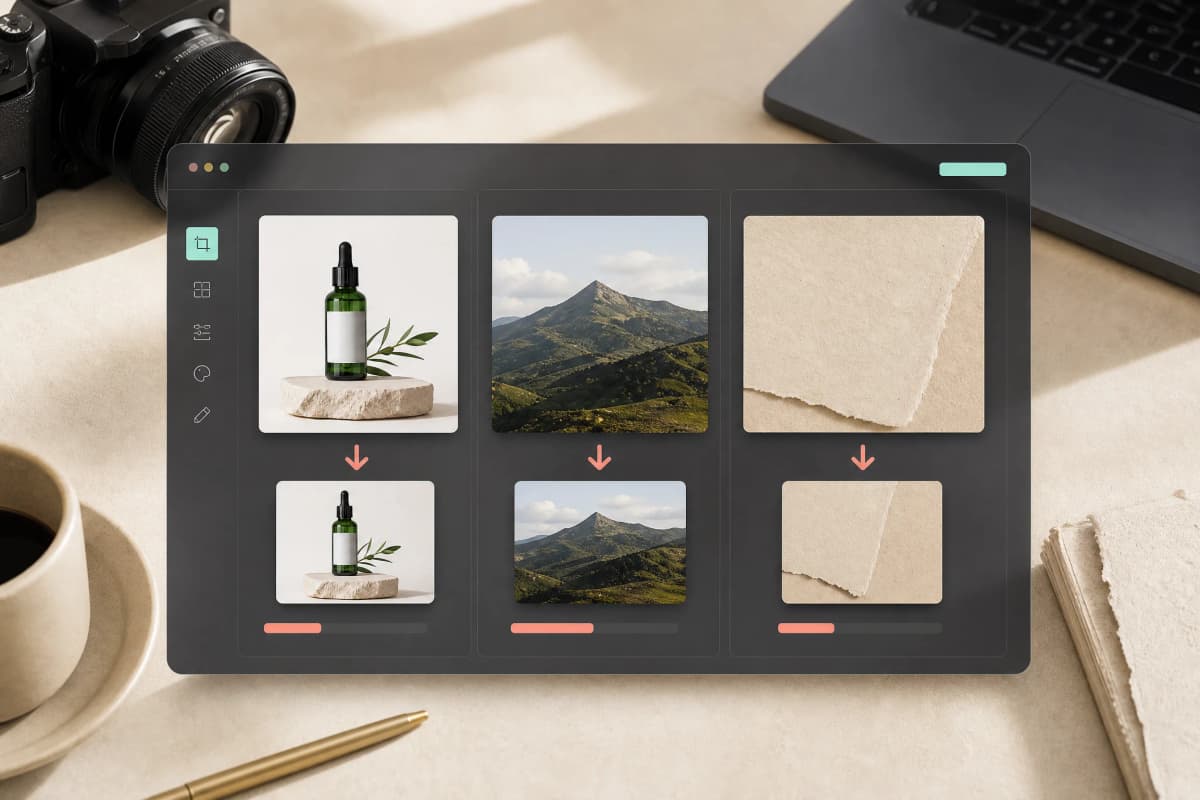
Motionix Image Compressor is the best fit in this roundup when you want a privacy-first, browser-based workflow with a quality preview. If you need client-side, codec-level tweaking, Squoosh exposes in-browser previews and encoder choices. If you prefer a one-click, upload-based workflow, TinyPNG is a widely used option with a separate developer offering. For quick drag-and-drop jobs, ImageCompressor and similar web apps may be convenient. This is a feature-and-fit comparison, not a controlled performance test: I did not perform hands-on testing, so verify current limits, formats, pricing, privacy terms, and features on each vendor’s site.
The 10 free or limited-free image compressors (decision-led list)
-
Motionix Image Compressor (best privacy-first, browser-based)
- Processing: local, in-browser compression and basic resize.
- Why choose it: Keeps files local unless you export, no account required, quick presets for common formats.
- Good for: Content creators who prioritize privacy and a fast, no-friction resize + compress workflow.
-
Squoosh (best for codec control and previews)
- Official site: Squoosh
- Processing: client-side, in-browser.
- Why choose it: Exposes encoder settings for MozJPEG, WebP, AVIF and others with visual previews.
- Good for: When you want to experiment with quality settings and codecs before publishing.
-
TinyPNG / TinyJPG (best for predictable server-side compression and API options)
- Official site: TinyPNG
- Processing: server-side uploads (web interface) with documented API for developers.
- Why choose it: Simple drag-and-drop flow and a clear path to automation via API if you scale up.
- Good for: Teams that want consistent, low-effort results and developer integration later.
-
ImageCompressor (best for quick, no-signup single-image jobs)
- Official site: ImageCompressor
- Processing: web app in your browser.
- Why choose it: Very simple UI and fast for one-off tasks without signups.
- Good for: Quick compress-and-download when you do not need advanced codec controls.
-
ShortPixel Online Image Compression
- Official site: ShortPixel Online Image Compression
- Processing: web-based compression with documented size and format limits that can change.
- Why choose it: A hosted option for quick JPG, PNG, and GIF compression when a browser-local workflow is not required.
- Good for: Users who want a simple upload-based compressor and can review the current terms first.
-
Compress-Or-Die
- Processing: web app offering advanced encoder controls.
- Why choose it: Precise control for users concerned about artifacts and technical output.
- Good for: Technical users who want minute control over encoder settings.
-
Kraken.io (free web interface available)
- Processing: web interface and developer tools.
- Why choose it: Polished UI with lossy/lossless options and scaling paths for developer workflows.
- Good for: Teams that may need both a web tool and developer integrations.
-
iloveimg
- Processing: web-based suite (resize, crop, compress).
- Why choose it: Simple toolbox for basic image edits and compression.
- Good for: Quick editing plus compression in a single site.
-
EZGIF
- Processing: web-based image and GIF tools.
- Why choose it: Handy for GIF and small image edits and compressions where format conversion is needed.
- Good for: Users working with animated GIFs or needing simple conversions and optimizations.
-
ImageOptim (desktop app; free)
- Processing: local desktop optimization (Mac).
- Why choose it: Local batch optimization without uploading; integrates into local workflows.
- Good for: Users who prefer a desktop tool rather than a web app for privacy and batch processing.
Note: Tool feature sets and available formats change over time. Check each official site for the latest details.
Comparison at a glance
| Tool | Processing model | Formats (examples) | Signup required | Best use |
|---|---|---|---|---|
| Motionix Image Compressor | Browser-based (local) | JPG, PNG, WebP (presets) | No | Privacy-first, quick resize+compress |
| Squoosh | Client-side (in-browser) | JPG/MozJPEG, PNG, WebP, AVIF | No | Fine-grained codec and quality control |
| TinyPNG / TinyJPG | Server-side (upload) | PNG, JPG (and WebP conversions) | Optional (for API) | Simple workflows and API integration |
| ImageCompressor | Web app (in-browser) | JPG, PNG, GIF (common) | No | Fast, no-friction single-image compression |
| ShortPixel Online Image Compression | Web app (upload) | JPG, PNG, GIF (check current limits) | Check current terms | Hosted one-off compression |
| Compress-Or-Die | Web app | Multiple advanced codecs | No | Technical users demanding artifact control |
| Kraken.io | Web app + dev tools | JPG, PNG, GIF | Optional | Polished UI and developer workflows |
| iloveimg | Web app suite | JPG, PNG, GIF | No | Quick edits plus compression |
| EZGIF | Web app | GIF, PNG, JPG | No | GIF-focused editing and compression |
| ImageOptim | Desktop (local) | JPG, PNG, GIF | No | Local batch optimizations (Mac) |
How to choose: privacy, control, or convenience
- Privacy first: Choose client-side tools (Motionix, Squoosh, ImageOptim) so images do not leave your device.
- Precise control: Choose Squoosh or Compress-Or-Die to tweak codecs, quantizers, and preview artifacts.
- Quick convenience: Use Motionix, TinyPNG, or ImageCompressor for fast one-click results.
- Automation and scale: Pick a tool with an API or CLI (TinyPNG, Kraken.io or a dedicated local CLI) for build pipelines.
- Batch work: Desktop apps or batch web UIs can save time when processing many files; confirm current limits before uploading a large batch.
Practical trade-offs:
- Client-side = more privacy and no upload delays, but you handle processing on your machine.
- Server-side = usually consistent, sometimes smaller outputs, but requires upload and you should review terms.
Quick workflows (concrete steps)
Prepare blog images
- Resize to the exact display dimensions first using the photo resizer tool.
- Compress: use Motionix or Squoosh depending on whether you prefer privacy or codec tuning.
- Check at 100% zoom for visible artifacts.
- Export web-ready formats and keep originals.
Convert to WebP/AVIF
- Read format trade-offs in our format guide.
- Use Squoosh to preview conversions and compare quality vs. size.
- If you prefer a one-click route, use TinyPNG or a converter that supports WebP.
Automate for a website
- Choose a service with a documented API (for example TinyPNG) or a local CLI tool.
- Integrate compression into your build or upload pipeline so images are optimized before deployment.
Helpful links:
- Guide to resizing images: Photo resizer
- How to compress images without losing quality: Compress images without losing quality
- Format comparison: JPG vs PNG vs WebP vs AVIF
Quality checklist before publishing
Choose a tool for the destination, not only the smallest file in a comparison. For Outlook signatures, readable text and predictable displayed dimensions are more important than an arbitrary byte target. Start with the resizer's email preset and inspect the result in a received message.
- Resize to display size to avoid shipping oversized files.
- Pick the right format: PNG for transparency, JPG for photos, WebP/AVIF where supported.
- Preview at 100% after compression to catch artifacts.
- Keep master originals for future re-exports.
- Automate repeatable work with an API or local tools when processing at scale.
Motionix publisher note Motionix publishes this comparison to help you decide. We did not perform hands-on testing for this article. Features, file-size limits, APIs and terms change over time; verify current details on each tool’s official site before committing to a workflow.
Frequently asked questions
Are these compressors really free?
Most offer free web interfaces for one-off use. Several also provide paid plans, API limits, or desktop apps. Check each vendor’s site for current pricing and limits.
Is client-side compression always better for privacy?
Client-side tools avoid uploading image pixel data to third-party servers, which improves privacy. If you handle sensitive or regulated content, prefer local or in-browser tools.
Will converting to WebP or AVIF always reduce file size?
Often for photographs WebP and AVIF give smaller files at similar quality, but results depend on the source image and chosen quality settings. Preview conversions before publishing.
How do I avoid visible artifacts when compressing?
Start with conservative quality settings and compare originals and compressed files at 100% zoom. If artifacts are visible, increase quality or try a different encoder.
Can I automate compression for a website?
Yes. Use tools or services that offer APIs or CLIs to integrate compression into build pipelines. Check each tool for developer documentation and API terms.
Should I keep original images after compression?
Yes. Keep master originals so you can re-export at different sizes or formats later without cumulative quality loss.
References
- Squoosh: official source
- TinyPNG / TinyJPG: official source
- ImageCompressor: official source
- ShortPixel Online Image Compression: official source
- Compress-Or-Die: official source
- Kraken.io web interface: official source
- iLoveIMG compressor: official source
- EZGIF optimizer: official source
- ImageOptim for Mac: official source
- Shopify image optimization guide: official source
Try Motionix’s privacy-first browser image compressor to resize and compress images before you publish: Motionix image compressor.
Related Motionix tools and guides
compress images without losing quality · jpg vs png vs webp vs avif · photo resizer
Keep reading

video ·
Extract a Video Frame as PNG Without a Screenshot
Save a decoded video frame for a thumbnail or document, check the selected moment and dimensions, and avoid mistaking PNG export for video repair.
Read
subtitles ·
Fix Subtitle Timing: Offset or Gradual Drift?
Work out whether subtitles need a constant shift or two-point drift correction, then check the repaired SRT or VTT against your actual video.
Readvideo ·
Make a Video Contact Sheet for a Useful Visual Overview
Create a timestamped grid of video frames, choose sampling that suits your review, and understand what a contact sheet can miss.
ReadConversation
Join the conversation
Share a useful question, correction, or practical tip. Comments are reviewed before they appear.
Loading…